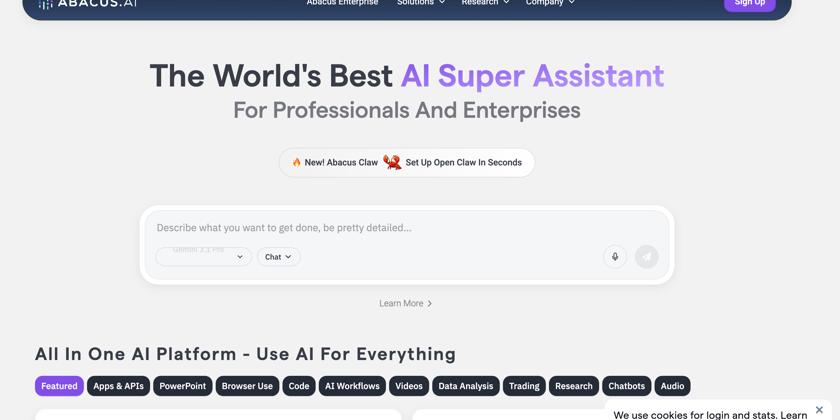
Abacus.ai - The AI Platform That Picks the Right Model for You So You Don't Have To
Are you still opening three different browser tabs every time you have an AI task? One for code generation, one for creative writing, one for image creation and then spending five minutes deciding which model handles this particular request best?
You're not alone. I've been there too.
As a software engineer who has spent the last 15 years building systems that eliminate unnecessary decisions, I find it ironic that we've created a world where accessing AI intelligence now requires more cognitive overhead than ever. We solved the "which search engine" problem in the 90s. We're still solving the "which AI model" problem in 2025.
That's the exact problem Abacus.AI was built to fix. And after spending time inside the platform, I think they've come closer to solving it than anyone else.
Abacus.AI is an all-in-one AI super assistant that automatically routes your request to the most appropriate AI model whether that's GPT-5, Claude, Gemini, Grok, or a specialized image/video generator. Instead of you deciding which AI fits which task, the platform's internal routing system (called RootLLM) makes that decision for you. For $10/month, you get access to every major AI model, a Deep Agent that builds real deployable applications, and a secure enterprise-grade environment all from a single interface.
If you're a knowledge worker, developer, or entrepreneur who uses AI daily, this platform is worth a serious look.
The best AI setup means nothing if you're not tracking where your money goes.
I use a free tool I built to monitor my ETFs, crypto, and real assets in one place no spreadsheets, no subscriptions.
That's how I connect smarter work to smarter wealth.
-> Get Portfolio Tracking App
What Is Abacus.AI? (The 60-Second Definition)
Abacus.AI is a unified AI platform that describes itself as "The World's First AI Super Assistant for Professionals and Enterprises." It is not a single AI model it is an orchestration layer that sits on top of all major AI models and intelligently routes your requests to whichever model is most likely to give you the best result for that specific task.
Think of it the way Jensen Huang, NVIDIA's CEO, framed the AI revolution at GTC: a five-layer cake, with applications and agents at the top. Abacus.AI is squarely in that top layer it is an application built on AI, not the AI itself.
At its core, it bundles:
- ChatLLM access to every major language model in a single chat interface
- Deep Agent an agentic mode that builds real, working applications from a single prompt
- Abacus Claw a secure, private instance of OpenClaw (open-source AI) you can spin up in seconds
- Media Generation image, video, and audio creation from leading generators (Midjourney, Flux, Kling, Luma, ElevenLabs, and more)
- Desktop App a local, offline-capable version for privacy-conscious users
Why Does AI Tool Switching Actually Cost You?
The Hidden Tax of "Which AI Should I Use?"
Here's what most people don't measure: the decision cost of choosing an AI model.
Before you even type a single character, you've already spent mental energy answering: Is this a creative task or a technical one? Is Claude better for long-form reasoning here? Should I use GPT-5 for the code? What about the image Midjourney or Flux?
This is called decision fatigue and it compounds. By the time you've made five model-switching decisions before noon, you've burned cognitive fuel that should have gone into your actual work.
As someone building multiple income streams alongside a software engineering career, I know how precious that cognitive bandwidth is. Every unnecessary decision is a tax on your 3rd Income Channel the creative, leveraged work that actually builds toward financial freedom.
What the Research (and My Own Experience) Says
Studies on decision fatigue consistently show that the quality of decisions deteriorates after a series of choices regardless of how trivial those choices seem. Choosing between AI models ten times a day isn't trivial. It's a pattern of low-grade cognitive drain that accumulates silently.
I spent weeks deliberately tracking which AI tool I opened for which task. The result? I was using five different tools and switching context an average of 11 times per day. That's not a workflow. That's chaos wearing the costume of productivity.
How Abacus.AI Works The Core Architecture
The Routing Brain: How the System Picks the Right Model
The most important component in Abacus.AI is an internal model called RootLLM a proprietary AI layer that analyzes your prompt and decides which underlying model is best equipped to handle it.
You type your request. RootLLM reads it, categorizes the task type, and dispatches it to the optimal model silently, automatically, in the background.
- Writing code? It routes to the best available code model (GPT Codex, Claude Sonnet, etc.)
- Generating creative content? It selects the strongest generative model for that task type.
- Building something complex with multiple steps? It activates Deep Agent mode.
You never see the routing happen. You just see the result.
Here's what makes it different: this isn't just a chatbot wrapper around multiple APIs. The routing decision is dynamic and context-aware. The same platform that processes your Python debugging question also handles your investor deck research and uses completely different underlying models for each.
Deep Agent Mode: From Chat to Fully Working Product
This is where things get genuinely impressive.
Deep Agent is Abacus.AI's agentic execution layer it doesn't just answer questions, it builds things. Give it a prompt, and it will produce a functional, deployable product: a web application with Stripe integration, a mobile fitness tracker, a CRM system, a Telegram bot, a professional PowerPoint presentation.
Let me walk you through what I tested:
I asked it to build a Telegram bot that collects the top 24 hours of tech news every morning and delivers it directly to my Telegram channel. Deep Agent didn't just generate code it gave me:
- A step-by-step setup guide (create the bot via BotFather, obtain the API token, configure the news sources)
- The actual implementation code
- A deployment checklist
- Proactive troubleshooting guidance for common failure points
At no point did I select a model. Deep Agent handled all routing decisions internally. The entire session felt like pair programming with a senior engineer who also happens to know Telegram's API documentation by heart.
Abacus Claw: Open-Source Meets Enterprise Security
Abacus Claw is a one-click deployment of OpenClaw an open-source AI framework running inside Abacus.AI's secure, private infrastructure.
This is particularly relevant if you're using AI for sensitive business tasks: financial modeling, client data analysis, proprietary code review. Rather than sending data to a third-party API you don't control, Claw gives you the capability of open-source AI with the security envelope of an enterprise platform.
Binaries, no configuration, no DevOps headaches. The creator of OpenClaw has reportedly said he builds everything by voice, without typing. Claw is the environment that makes that workflow possible at scale.
The Media Layer: Images, Videos, and Audio in One Place
Beyond text and code, Abacus.AI consolidates every major media generation tool:
Image Generation:
- Midjourney, Flux, Ideogram, Recraft
Video Generation:
- Kling 3.0, Runway, Luma
Audio Generation:
- ElevenLabs, OpenAI, Hum
For content creators and developers building products that require multimedia a newsletter, a landing page, a social media automation having all of this under one roof eliminates another category of tool-switching entirely.
Real-World Use Cases I Tested
Use Case 1 Building a Telegram Morning Briefing Bot
Goal: Receive a curated summary of the top 24-hour tech developments every morning, automatically, via Telegram.
What happened: I typed the request in plain language. Deep Agent selected its own model combination without prompting. It then generated a complete implementation guide from BotFather bot creation to API configuration to news source integration. When I asked it to explain steps "as if I'm five years old," it adapted its language immediately.
Result: A working bot blueprint, ready for deployment, produced in one session.
Use Case 2 Vibe Coding a CRM
Goal: Build a functional contact and deal management system without writing code manually.
What happened: Deep Agent interpreted the brief, chose a tech stack, built the data model, generated the frontend and backend, and presented a working CRM prototype complete with guided next steps for customization.
Time invested: Under 20 minutes of prompting.
Use Case 3 Generating a Professional Presentation
Goal: Create a data-rich presentation on a complex topic (example: history of money and financial systems).
What happened: Deep Agent conducted research, selected visuals, structured slide content, applied formatting logic, and produced an investor-ready deck. Real-time chat intervention allowed me to adjust colors, add specific data points, and restructure sections mid-generation.
Pricing: Is $10/Month Actually Worth It?
Let's be direct about this.
At $10/month, Abacus.AI's ChatLLM plan gives you access to every major AI model on a single platform, Deep Agent capabilities, media generation tools, and the Abacus Desktop app.
Now, to be fair: Abacus.AI gives you access to these models, not unlimited API-level calls at every tier. Heavy professional users may hit usage limits on certain models. But for the majority of knowledge workers, developers, and builders the $10 plan is a legitimate consolidation play.
The relevant question isn't "is it cheaper?" (it clearly is). The question is: does consolidation reduce the switching overhead enough to justify the trade-off? Based on my usage, the answer is yes.
What Abacus.AI Does NOT Do (Honest Limitations)
Because every tool review should include what a tool isn't:
- It is not a replacement for specialized, heavy-use workflows. If you're a professional video editor using Runway with custom settings daily, the native interface gives you more control than Abacus.AI's wrapper.
- The routing system isn't perfect. Occasionally, RootLLM selects a model that isn't optimal for a niche task. You can override this manually, but it requires knowing which model to request.
- Deep Agent builds MVPs, not production-grade enterprise systems. The output requires review, testing, and hardening before deployment in serious environments.
- Claw requires an upgrade beyond the base $10 tier to unlock full functionality.
These are real limitations. They don't disqualify the platform they define who it's for.
Who Should Use Abacus.AI?
Abacus.AI is designed for three distinct user types:
Knowledge Workers & Content Creators: If you currently use 3+ AI tools and spend time daily deciding which one to open, this platform eliminates that overhead entirely. The consolidation value alone justifies the $10/month.
Developers & Technical Founders: Deep Agent is a genuine productivity multiplier for MVP development, rapid prototyping, and automation workflows. If you've been experimenting with vibe coding, this is the most complete environment for it.
Entrepreneurs Building Side Income Streams: From a DML Financial Freedom Model perspective if you're at the Portfolio Ownership or Financial Security stage, building AI-powered tools and automations as your 3rd Income Channel requires maximum output per unit of time. Abacus.AI compresses the tool-switching overhead that eats into that time budget. Fifteen minutes saved on tool selection every day is 90 hours recovered per year. That time goes back into building.
Final Thoughts
The "which AI should I use?" problem has been an invisible tax on productivity since the proliferation of large language models began. Abacus.AI is a serious attempt to solve it not by betting on a single model, but by building a routing intelligence layer that makes the decision for you.
Here's what stands out after hands-on testing:
- The RootLLM routing system works well for 80–90% of everyday tasks without manual intervention
- Deep Agent genuinely builds functional prototypes, not just code snippets
- The $10 price point is the most aggressively positioned consolidation offer in the current market
- Abacus Claw fills a real gap for privacy-sensitive AI work
If you're a developer, builder, or knowledge worker who values systems over scattered tools Abacus.AI deserves a serious evaluation.
The best AI setup means nothing if you're not tracking where your money goes.
I use a free tool I built to monitor my ETFs, crypto, and real assets in one place no spreadsheets, no subscriptions.
That's how I connect smarter work to smarter wealth.
-> Get Portfolio Tracking App