
Emergency Fund Coverage: If You Lost Your Job Tomorrow How Many Days Could You Survive?
The rule sounds reassuring. Save three to six months of expenses, and you're covered. Financial advisors repeat it. Personal finance articles echo it. It's practically gospel.
But here's what they leave out: three months of expenses means something completely different depending on who you are.
A Number Without Context Is Meaningless
If you spend $3,000 a month, three months of savings means $9,000. If you spend $10,000 a month, three months means $30,000. Both are "three months" but one person lives in a fundamentally different risk environment than the other.
Now flip it. You have $18,000 in savings.
- If your monthly expenses are $2,000 → that's 9 months of coverage
- If your monthly expenses are $9,000 → that's 2 months of coverage
Same balance. Completely different reality.
This is the problem. A dollar figure sitting in a savings account doesn't tell you how long it will protect you. And in a high-inflation environment where every month that money sits there it buys less than it did before a static number is even less meaningful.
The better question isn't "how much do I have?" It's: how many days does that actually buy me?
What Is Emergency Fund Coverage?
Emergency Fund Coverage is a metric that calculates the exact number of days your emergency fund can sustain your lifestyle, accounting for passive income that continues even when your active income stops.
The formula:
Daily Net Expense = (Monthly Expenses − Monthly Passive Income) / 30
Emergency Fund Coverage = Emergency Fund Balance / Daily Net Expense
No currency. No estimates. Just a number in days precise, personal, and immediately actionable.
Why Passive Income Is Subtracted
This is the part that surprises most people. Why subtract passive income from expenses?
Because passive income doesn't stop when your job does.
Think about it: if you lose your salary tomorrow, your dividend payments still arrive. Your rental income still deposits. Any royalties, digital product sales, or interest income still flowing. Your active income disappears. Your passive income doesn't.
So the emergency fund only needs to cover the gap between your expenses and your passive income. Calculating it any other way overestimates your actual vulnerability and underestimates how much your passive income channels are already protecting you.
Same Fund, Two Different Realities
Let me make this concrete. Here are two profiles with the same emergency fund but very different coverage numbers.
| Profile A | Profile B | |
|---|---|---|
| Monthly Expenses | $3,000 | $3,000 |
| Passive Income | $0 | $1,000 (33%) |
| Daily Net Expense | $100/day | $67/day |
| Emergency Fund | $9,000 | $9,000 |
| Coverage | 90 days | 135 days |
Profile A and Profile B have identical expenses and identical savings. But Profile B has 45 extra days of coverage purely because of $1,000/month in passive income.
Let that sink in for a moment.
No extra savings. No budget cuts. Just passive income reducing the daily financial pressure and the same fund stretching 50% further.
How Many Days Is Enough?
Now that you know how to calculate it, here's how to interpret your number:
0–30 days    → Critical      — Immediate action required
30–60 days   → Insufficient  — Build this up now
60–90 days   → Adequate      — Standard safety level
90–180 days  → Strong        — Comfortable coverage
180+ days    → Excellent    — Full financial buffer
These ranges aren't arbitrary. They connect directly to the DML Financial Freedom Model a five-stage framework for measuring and building financial independence:
- Stage 2 (Financial Stability): Minimum 30 days coverage recommended
- Stage 3 (Portfolio Ownership): Target 60 days minimum
- Stage 4 (Financial Security / FIRE): 90 days is the baseline requirement
Knowing which stage you're in tells you exactly what coverage level to aim for and makes your emergency fund goal a system output, not a guess.
How Emergency Fund Coverage Works in ProjXplorer
ProjXplorer tracks six core financial metrics on its dashboard. Emergency Fund Coverage (Days) is one of them displayed with a green shield icon.
Here's how it works in practice: you define your emergency fund as a separate line item inside ProjXplorer's portfolio tool. The system already knows your monthly expenses and passive income from your other inputs. It combines those automatically, runs the formula, and shows you your coverage in days updated whenever your numbers change.
No spreadsheet. No manual calculation. No formula to remember.
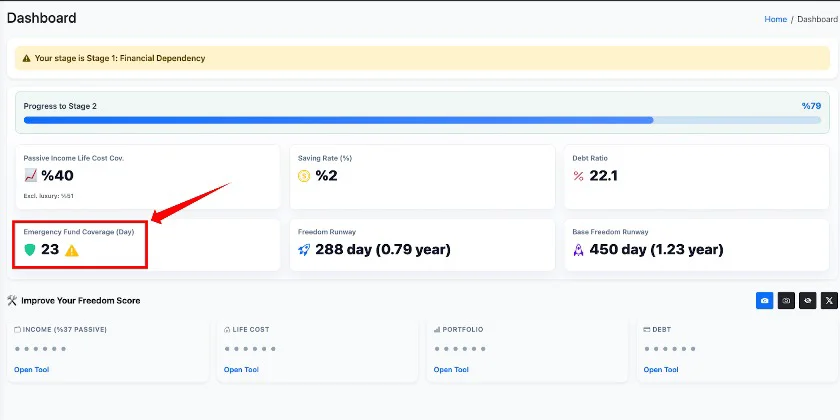
ProjXplorer is free and available as a PWA. You can start tracking all six metrics including your Freedom Runway, Passive Income Ratio, and Savings Rate at projxplorer.com.
Where Should You Keep Your Emergency Fund?
Having the right coverage number is step one. Keeping the money in the right place is step two and this is where a lot of people make a costly mistake.
Your emergency fund has one job: be available exactly when you need it most.
That means it cannot be in the stock market. Think about what happens in a real emergency job loss, medical crisis, unexpected expense. These events are often correlated with broader economic stress. The market might be down 20% at the exact moment you need to withdraw. Selling at a loss isn't a safety net. It's a double loss.
Where it should be:
- High-yield savings account accessible, earns interest
- Money market fund liquid, slightly better returns
- Short-term treasuries or CDs for the portion you won't need immediately
- A portion in gold or inflation-hedged assets to preserve purchasing power over time
The priority order is: liquidity first, return second.
A fund that earns 4% annually but takes 5 business days to access is less useful in a genuine emergency than a fund earning 2% that you can tap tomorrow morning.
3 Ways to Increase Your Coverage
If your current coverage falls below your target level, there are three levers you can pull. They work independently but they work best together.
Way 1 Increase the Fund Balance
The most direct approach. Set up an automatic monthly transfer to a liquid account and don't touch it. Small, consistent contributions build significant coverage over time especially when you remove the decision from the equation entirely.
This feeds directly into the Cash Bucket of the 3-Bucket Strategy: the first bucket exists precisely for liquidity, emergency access, and short-term stability.
Way 2 Reduce Monthly Expenses
You don't need to add more money to increase your coverage. You can also reduce the denominator your daily net expense.
If your monthly net expenses drop from $3,000 to $2,400, your daily expense goes from $100/day to $80/day. The same $9,000 fund goes from covering 90 days to 112 days no additional savings required.
The fastest wins come from cutting recurring discretionary expenses: subscriptions you've forgotten about, services you barely use, lifestyle inflation that crept in silently. ProjXplorer's spending breakdown surfaces these quickly.
Way 3 Grow Passive Income
This is the most strategic lever and the one with compounding effects.
Every dollar of monthly passive income you add reduces your daily net expense. Reduced daily net expense means the same fund lasts longer. Longer coverage means more financial security without hoarding cash.
Building your 3rd Income Channel dividends, rental income, digital products, royalties is the core growth engine of the DML model precisely because it works on multiple metrics simultaneously. It increases your Passive Income Ratio, lowers your required active income, and extends your emergency fund coverage. All at once.
Knowing Your Number Is the Beginning of Real Security
Financial security isn't a feeling. It's a measurable metric.
If you can't answer "how many days could I survive without my salary?" with a specific number not a range, not a rough estimate, but a number then you don't actually know where you stand.
The classic advice to save 3–6 months of expenses isn't wrong. It's just the beginning of the conversation, not the end. Emergency Fund Coverage takes that advice and makes it personal, precise, and actionable.
Your number might be 41 days. It might be 135. It might be exactly where you want it or it might tell you something needs to change.
Either way, knowing beats guessing. Always.