
The Money Cycle Has 3 Phases. Skipping the Middle One Is the Most Expensive Mistake in Investing.
Investing without understanding the money cycle is like building a highway with no exit ramp. You know where you started. You think you know where you're going. But the transition is where everything falls apart.
The Money Cycle: A Framework Everyone Lives Through, But Almost Nobody Names
When I started thinking systematically about financial freedom drawing on 15 years of software engineering experience I noticed something. The biggest mistakes rarely come from wrong moves. They come from skipped steps.
The money cycle is exactly that kind of skipped step.
Everyone goes through it. But very few people manage it consciously. The cycle has three distinct phases: Accumulation, Preservation, and Distribution. Understanding all three and knowing which one you're in is the difference between a financial plan and financial luck.
Phase 1: Accumulation Building the Machine
Accumulation starts earlier than most people think.
The piggy bank. The first part-time job. The savings account you opened in your twenties. As you move into adulthood, it scales up: salary contributions, a retirement fund, an investment portfolio. The single goal of this phase is to grow your assets.
Here, a higher risk tolerance makes sense because time is on your side. If the market drops, you can wait. If a position underperforms, you can rebalance. Time is your most valuable asset in this phase, and the math works in your favor.
Within the DML Financial Freedom Model, this phase maps to the journey from Financial Dependency through Portfolio Ownership. Your savings rate climbs. Your Freedom Runway lengthens. Passive income starts taking shape slowly, then all at once.
But one day, this phase ends. And most people don't notice when it does.
Phase 2: Preservation The Phase Most Investors Skip
This is where things get interesting.
Around 10 years before retirement or shortly before reaching financial independence the rules of the game change. Maximizing growth is no longer the priority. Protecting what you've already built becomes the job.
"It's not about how much you make. It's about how much you keep."
That one sentence summarizes what most investors ignore for decades.
Preservation means strategically repositioning a portion of your assets away from high volatility. Growth continues but at a controlled pace, enough to outpace inflation. Because you'll need this money soon. You no longer have years to wait for a recovery.
So what do most people actually do?
They stay fully aggressive right up to the finish line. Then they retire. Then they start withdrawing.
The Preservation phase never happens.
WARNING: This Is Where the Real Danger Starts
Let's talk about 2000. And 2008.
From September 2000 to September 2003, the market dropped 44.7% and took 49 months, more than four years, to recover its previous high. From November 2007 to February 2009, it fell 50.9% and needed 37 months to recover.
Now picture an investor who entered retirement right at those peaks. Fully invested. No Preservation layer. Geçim için para çekmesi gerekiyor but the market is in freefall.
Here's the double whammy:
- Your investments are losing value
- At the same time, you're selling those declining assets to pay for living expenses
That money never comes back. The portfolio erodes at an accelerated pace. And time the one asset that saved you during Accumulation is now gone.
Investors who panicked sold at the bottom, locking in permanent losses. Those who held on still faced years of income pressure with no good options. Both outcomes become almost inevitable when Preservation is skipped.
Phase 3: Distribution Living From What You Built
Distribution is the final phase of the cycle.
You're no longer building you're drawing. In retirement, for yourself. Eventually, for the people you leave behind. But this phase isn't just "start withdrawing." It requires its own strategy: which assets do you draw from first? In what order? What's the tax impact? How much does your passive income already cover?
Within the DML Financial Freedom Model, this is the Financial Security (FIRE) and Financial Freedom stages. Freedom Runway is effectively infinite or long enough to last a lifetime.
But arriving here intact requires all three phases to run in sequence.
So What Does Preservation Actually Look Like?
Preservation isn't an abstract concept it's a concrete portfolio decision.
Here's the core idea: as your portfolio grows and you move closer to financial freedom, increasing the weight of income-generating, lower-volatility instruments isn't optional. It's a system requirement.
Why? Because the real danger isn't volatility itself it's being forced to sell during volatility. As long as you don't withdraw, paper losses don't permanently damage your portfolio. The damage becomes permanent the moment you sell declining assets to fund your living expenses.
This is why the Preservation phase exists: to build a buffer that means you never have to sell at the wrong time.
In practice, this means shifting portfolio weight toward instruments like:
- Eurobonds / Government bonds: Fixed coupon payments, relative independence from equity market swings. Predictable cash flow without needing to sell anything.
- Rental income: A strong hedge against inflation. Your asset stays intact while generating regular income.
- Dividend income: The most natural way to stay invested in equities while generating passive income. Even when share prices dip, dividends can continue to flow.
What these three have in common is straightforward: they generate income without requiring you to sell. That's the entire point of Preservation.
The goal in the Distribution phase is to live from what your portfolio produces not from selling pieces of it. The difference between those two approaches, compounded over decades, determines whether your portfolio outlasts you or runs dry. How to manage withdrawals once Distribution begins is a deep topic in its own right one we'll cover in a separate article.
Thinking in Systems Changes Everything
After 15 years of building software systems, one lesson has stayed with me: ungoverned growth is not controlled growth.
In engineering, shipping to production without proper testing invites failure. Skipping Preservation in your financial system is the same class of error you're bypassing the most critical handoff point in the entire lifecycle.
When I built ProjXplorer, I wanted to make these three phases concrete and measurable. That's exactly where metrics like Freedom Runway and Passive Income Ratio come in. They don't just tell you how much you have they tell you which phase you're in and what your next move should be.
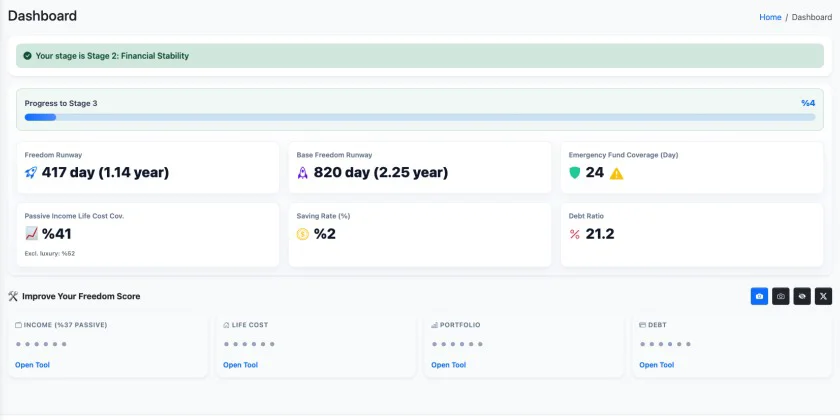
The money cycle isn't abstract. It's measurable, manageable, and optimizable like any well-designed system.
Final Thoughts
Accumulation, Preservation, Distribution. Three phases. Everyone lives through them. But the gap between those who manage them consciously and those who don't shows up clearly in retirement.
Building wealth is not enough. Knowing when to shift into protection mode and how is what separates a solid financial plan from an expensive lesson learned too late.
Which phase are you in right now?
If you want to think about your financial freedom journey more systematically, join. It is FREE.