
Emergency Fund Guide: How Much, Where, and How to Build It
Financial Cockpit in your pocket. Manage your budget and investments anywhere. And it's free!


In July 2026, my emergency fund covered almost 90 days of expenses.
Today it covers 3.
Two unexpected large expenses hit in the four months in between. Then a fund crisis in September pushed cash flow even tighter. At the same time, commodities, the Istanbul stock exchange, crypto, and nearly every US index were losing value.
I know exactly what I would have done without that fund. I would have liquidated assets near the bottom.
I know this because I've lived it before. Without a fund, I lost twice in the same portfolio.
This time I didn't touch the portfolio at all.
I've written eight separate articles on emergency funds: how big, where to keep it, what to do with debt, how it protects a portfolio. This guide ties all of it into one system. Fifteen years of software engineering experience taught me this: an emergency fund isn't a savings habit. It's the failover layer of your financial system.
How to Use This Guide
This guide answers the core emergency-fund questions directly, in order. Each section links to the article that covers it in depth. If you haven't built your fund yet, follow the sequence: definition, size, storage location, then the build and refill plan.
Jump straight to what you need:
- What is an emergency fund, and why does it come first? → If You're Investing Without an Emergency Fund, You're Doing It Wrong
- How big should it be? → How Big Should Your Emergency Fund Be?
- How many days will mine actually cover? → If You Got Laid Off Tomorrow, How Many Days Could You Last?
- Where should I keep it? → Where Should You Keep Your Emergency Fund?
- I have debt should I still build a fund? → Should You Build an Emergency Fund While You Have Debt?
- How does the fund protect my portfolio? → I Lost Twice in the Same Portfolio Because I Had No Emergency Fund
- Why does the order of returns matter? → These 2 Investors Started With the Same Average Return
What Is an Emergency Fund?
An emergency fund is a fast-access cash reserve, kept separate from your investments and your checking account, for expenses that are unplanned, non-negotiable, and can't wait. Its purpose isn't to generate a return. Its purpose is to stop you from going into debt or selling investments at a loss during a crisis. Job loss, a health issue, a sudden home or car repair these are the typical triggers.
In software, we'd call this a buffer layer.
While the rest of the system fluctuates, the buffer absorbs the sudden load. Without one, the load hits the system directly and breaks its weakest part.
In a financial system, the weakest part is usually the portfolio because a crisis often lands in the same window as a market downturn.
An emergency fund is: liquid, market-independent, single-purpose money.
It is not: a credit card limit, the balance in your checking account, or stocks you tell yourself you'd "sell if you had to."
Read more: If You're Investing Without an Emergency Fund, You're Doing It Wrong
Why It Comes Before Investing
An emergency fund comes before investing because, without one, your portfolio doubles as your emergency account. When an unplanned expense hits, the portfolio is the only source left and the sale happens regardless of what the market is doing. That's why the DML Financial Freedom Model places the Financial Stability stage (your cash buffer) ahead of Portfolio Ownership.
I skipped that order myself.
At the end of 2025, I moved more than half my portfolio into gold. I had no cash layer. In 2026, moving costs, furniture, and education expenses piled up. I paid for all of it by selling assets.
The result was a double loss. First I sold at a low price. Then, once the price recovered, the units I'd sold were no longer mine to benefit from.
Here's the real lesson: the problem wasn't volatility. The problem was my liquidity structure.
The model has five stages: Financial Dependency → Financial Stability → Portfolio Ownership → Financial Security → Financial Freedom. The emergency fund is the gate to the second stage.
Read more: I Lost Twice in the Same Portfolio Because I Had No Emergency Fund
How Big Should Your Emergency Fund Be?
Your emergency fund should be 3 to 6 times your essential monthly expenses. If you're a single earner, self-employed, or in an unstable industry, push that target to 7–12 months. Count only your survival number: rent or mortgage, utilities, groceries, transportation, minimum debt payments, insurance, and medicine. The right number is wherever in that range lets you actually sleep well.
Formula: Fund target = Essential monthly expense × Coverage months
For someone with $30,000 in essential monthly expenses:
- 3 months → $90,000
- 6 months → $180,000
- 12 months → $360,000
Use the Pillow Test to find your own point in the range:
- Dual income, stable jobs, no dependents: 3–4 months
- Single, stable income: 4–6 months
- Single income with dependents: 6–8 months
- Self-employed or variable income: 8–12 months
- Homeowner or older vehicle: add 1–2 months
Most people make one of two mistakes here.
Too little, and the fund fails its one job: you go into debt or sell investments anyway during a crisis. Too much, and the excess cash sits earning little while inflation erodes it and your portfolio's growth gets delayed. If your target is 6 months but you're holding 12, that's $180,000 sitting idle in the example above.
Read more: How Big Should Your Emergency Fund Be?
Measure in Days, Not Months: Emergency Fund Coverage
Emergency Fund Coverage tells you how many days your fund can cover your net daily expense your expense after passive income is subtracted. You set your target in months; you track it in days. Passive income counts because it keeps arriving even if you lose your job: rent, dividends, or interest income don't stop. That's why the same fund buys different people a different amount of time.
The math is two steps:
Daily Net Expense = (Essential Monthly Expense − Monthly Passive Income) ÷ 30
Emergency Fund Coverage (days) = Emergency Fund ÷ Daily Net Expense
The same $90,000 fund and $30,000 monthly expense produce two different outcomes:
- Profile A: $0 passive income. Daily net expense: $1,000. Coverage: 90 days.
- Profile B: $10,000 passive income. Daily net expense: roughly $667. Coverage: roughly 135 days.
That 45-day gap is the quiet payoff of a third income channel.
Here's where you stand on that scale:
- 0–30 days: Critical
- 30–60 days: Insufficient Stage 2 (Financial Stability) requires at least 30
- 60–90 days: Adequate Stage 3 (Portfolio Ownership) requires at least 60
- 90–180 days: Strong Stage 4 (Financial Security) requires at least 90
- 180+ days: Excellent
My 3 days sit at the very top of that list. I'm not hiding it. Knowing the number is what tells me what to do next.
Read more: If You Got Laid Off Tomorrow, How Many Days Could You Last?
4. Full article Part 2
Where Should You Keep Your Emergency Fund?
An emergency fund should sit in instruments that are instantly accessible, protect your principal, and offer some resistance to currency depreciation. The priority order is always access, safety, return in that order. The main instruments that pass all three tests are high-yield savings accounts, money market funds, and a small amount of physical cash. Keep the fund separate from your checking account; money that sits in the same account you spend from tends to get spent.
Here's a rule I learned over 15 years: a failover system you can't reach isn't a failover system.
Suitable:
- High-yield savings account: Fast access, principal protected, earns interest.
- Money market fund: Low volatility. Confirm your bank's fund can be sold outside business hours.
- Physical cash (small amount): Instant access during a system outage.
Not suitable:
- Checking account: Accessible, but offers no protection against inflation or impulse spending.
- Stocks, crypto: A crisis can land in the same window as a market downturn.
- All cash at home: Theft risk, zero return.
I split my own fund into access layers: roughly one-third cash (mostly in a stable foreign currency, a smaller part in local currency), two-thirds in my bank's own money market fund. That ratio can shift to 1/4–3/4 depending on your own risk tolerance.
If your expenses are in a currency prone to losing value, your fund loses real purchasing power if it's held entirely in that same currency. Holding part of it in a harder currency is a reasonable hedge just don't sacrifice liquidity to do it.
Read more: Where Should You Keep Your Emergency Fund?
What It's For (and Not For): The Two-Bucket Model
An emergency fund is only for expenses that are unplanned, non-negotiable, and can't wait. Job loss, a health issue, a sudden repair all qualify. Opportunistic purchases, upgrades, and anything you already know is coming don't. Foreseeable large expenses still belong in cash just in a separate planned-expense bucket. The simple test: if you can see an expense coming six months out, it isn't an emergency. It belongs in the other bucket.
I lost money precisely because I didn't make this distinction.
Parts of my moving, furniture, and education costs were actually foreseeable. I treated them as "surprises." Because I had no separate bucket for planned spending, all of it landed on the same place: my portfolio.
Bucket 1: Emergency Fund
- Timing: Unknown
- Example: Job loss, hospital visit, a broken furnace
- Target: Essential expense × 3–6 months
- Saving: Up to the target, then stop
- On use: Refill it
Bucket 2: Planned-Expense Bucket
- Timing: Known, roughly dated
- Example: Tuition payment, car maintenance, vacation, a move
- Target: The amount of the expense
- Saving: Equal installments until the due date
- On use: That bucket closes, a new one opens
Planned-bucket formula: Monthly bucket contribution = Expense amount ÷ Months remaining
For a $36,000 bill due in 12 months, you'd set aside $3,000 a month into that bucket. When the date arrives, your emergency fund stays fully intact.
Should You Build an Emergency Fund While You Have Debt?
Yes. If you're carrying debt, build a small mini-fund first roughly one month of essential expenses then route extra cash to your highest-cost debt. The mini-fund stops small shocks from turning into new, more expensive debt. Your full target (3–6 months) can wait until the debt is cleared. Throughout, keep making minimum payments on every debt.
Write your decision rule down in advance so you're not deciding under stress:
- Are all minimum payments current? If not, handle that first.
- Does the mini-fund cover one month of essentials? If not, extra cash goes there.
- Is the mini-fund complete? If yes, extra cash goes to your highest-interest debt.
- Did an unexpected expense hit? Use the fund, then refill it before anything else.
Rank debts by cost, not balance. Example: a $60,000 debt at 4% monthly costs you $2,400 a month. A $30,000 fund earning 2% monthly earns you $600 a month. Once the mini-fund is done, the math is clear extra cash should go to the debt.
Read more: Should You Build an Emergency Fund While You Have Debt?
The Portfolio's Shield: Forced Selling and Sequence-of-Returns Risk
An emergency fund doesn't protect your portfolio from volatility. It protects it from forced selling and those are two different things. Volatility only turns into permanent damage when you're forced to sell during a downturn. With a fund in place, you cover expenses with cash while the market falls, and your holdings stay put to recover. Without one, every unexpected expense becomes a sale order placed at the worst possible time.
Here's the math, in a simplified example: you bought 10 units at $100. The price dropped to $80, and you had a $320 emergency expense.
- With a fund: The expense is covered from cash. You keep all 10 units. When the price recovers to $130, your position is worth $1,300.
- Without a fund: You sell 4 units at $80. You keep 6 units. When the price recovers to $130, your position is worth $780.
That gap is the double loss: you sold cheap, then missed the recovery.
This connects directly to sequence-of-returns risk. During accumulation while you're not withdrawing the order of your returns doesn't change your end result. Two investors who experience the same annual returns in reverse order end up almost exactly even after 10 years ($154,764 vs. $154,765).
The moment you start withdrawing, the rule changes. Of two investors each withdrawing $6,000 a year, the one who hits an early downturn ends up around $116,000; the one who hits an early rally ends up around $174,000. That's roughly a 1.5x gap.
An emergency fund keeps an unplanned expense from becoming a hidden "withdrawal" even during accumulation which means it keeps you from taking on sequence-of-returns risk you never signed up for.
Read more:
- These 2 Investors Started With the Same Average Return: return sequencing during withdrawals
- 10 Years Later, We Checked They Both Ended Up in the Same Place: return sequencing during accumulation
How to Build It: Step-by-Step Plan
You build an emergency fund by calculating your survival number, opening a separate account, automating a transfer on payday, and hitting intermediate targets at 30, 60, and 90 days of coverage. Waiting until you have a large lump sum to start is the single most common reason a fund never gets built. Small, regular transfers beat large, irregular ones. Once you hit your target, stop contributing and redirect the surplus to your portfolio.
Treat this like a software release: ship a first version, then iterate.
- Calculate your survival number. Subtract passive income from essential expenses, divide by 30.
- Open a separate account. Independent from your checking account, reachable instantly from a mobile app.
- Automate it. A fixed amount moves to the fund on payday, with no decision required.
- Route one-time income. Send a portion of bonuses, commissions, and refunds straight to the fund.
- Hit intermediate targets. 30 days first, then 60, then 90.
- Stop at target. Once you hit your goal, redirect the automated transfer to your portfolio or your planned-expense bucket.
Example: with a $1,000 daily net expense, setting aside $7,500 a month gets you to the 30-day threshold in 4 months and the 90-day threshold in 12.
After You Use It: The Refill Protocol
The first move after using your emergency fund is to pause new investment contributions and redirect all savings to the fund not to sell what's already in your portfolio. Your first goal is to get the fund back above the 30-day threshold, out of the critical zone. Using the fund isn't a failure. It's exactly what it's there for.
I'm at exactly this stage right now. 3 days.
Panic is the easy response. But the number tells a different story: the fund did its job. It covered my expenses while the markets fell, and my portfolio is still intact. Now it's time to rebuild the buffer.
Here's the right order once a fund is depleted:
- Log the use. Note when, for what, and how much.
- Pause new investing. Don't sell existing holdings just redirect new contributions to the fund.
- First target: 30 days. Don't treat anything as "back to normal" until you clear the critical zone.
- Trim expenses temporarily. A lower daily net expense stretches the same fund further.
- Analyze the cause. How much of the use was a true emergency versus something that belonged in the planned-expense bucket?
- Track it. Measure your coverage the same day each month and watch the trend.
Amateur reflex: "The fund's already gone might as well sell from the portfolio this once."
System reflex: "The fund's empty. New money goes there first; the portfolio is the last resort."
Tracking It in ProjXplorer
ProjXplorer lets you flag any asset in your portfolio as an emergency fund and automatically tracks your coverage in days. It combines that asset's live value with your income and expense data to calculate your Emergency Fund Coverage. The reason I put this metric front and center while building the app is simple: you can't manage a buffer you can't measure.
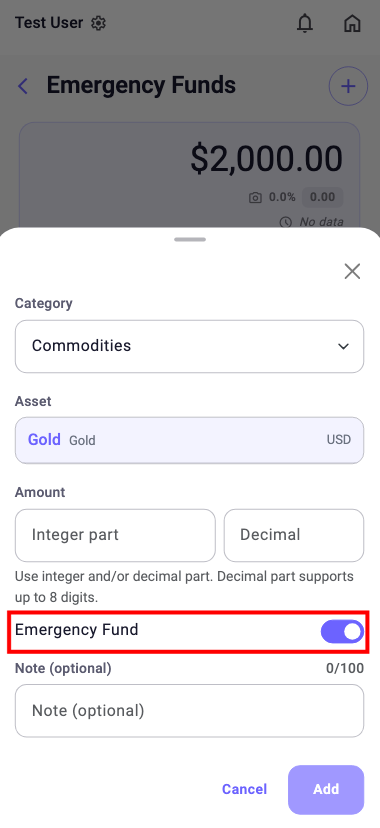
1. Flag the asset as an emergency fund. When adding or editing an asset in your portfolio, toggle on "Emergency fund."
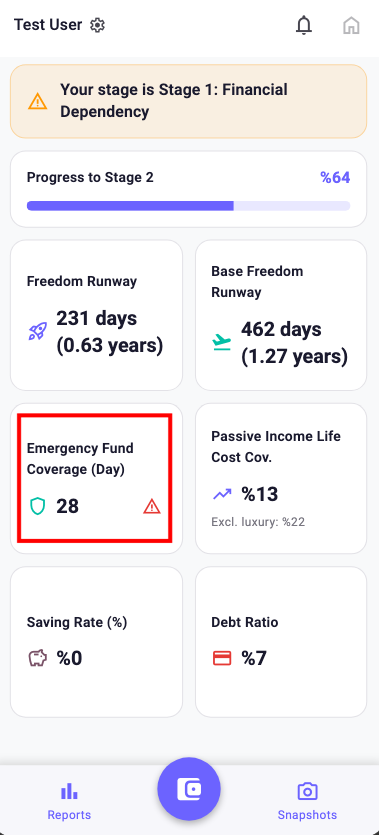
2. See your coverage on the dashboard. The "Emergency Fund Coverage (Days)" card shows how many days of expenses your fund covers, with a warning icon below the critical threshold.
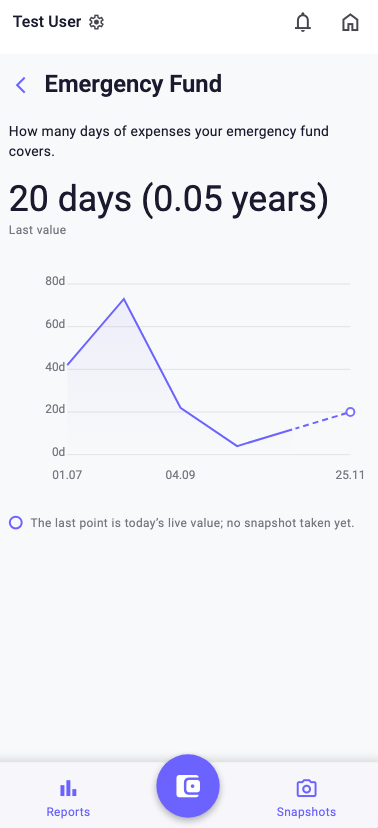
3. Track the historical trend in Reports. The Reports > Emergency Fund screen charts how many days your fund has covered at each snapshot.
The app is free. Use it from the ProjXplorer or on Google Play.
Emergency Fund Checklist
- I've calculated my survival number (essential monthly expenses)
- I've used the Pillow Test to set my target months
- I've measured my coverage in days
- My fund sits separate from my checking account, accessible 24/7
- Stocks and crypto are not part of my fund
- I have a separate bucket for planned expenses
- If I carry debt, I have at least a one-month mini-fund ready
- An automatic transfer is set up for payday
- I have a written refill sequence for if I use the fund
- I recalculate my target twice a year and after any major life change
Closing Thoughts: The Fund Didn't Fail It Did Its Job
I went from 90 days of coverage to 3 in four months.
I don't see that as a failure. The last time I faced a crisis without a fund, I lost twice in the same portfolio. This time I had one, and while nearly every market was falling, I didn't have to sell a single asset at a loss.
The difference was one layer.
Your turn:
- Calculate your survival number tonight.
- Divide your current fund by that number and write down your coverage in days.
- If that number is under 30, redirect your next investment contribution to the fund instead.
Do this, and the next time the market drops, you'll look at your portfolio with calm instead of fear.
My coverage went from 90 days to 3, and I tracked every step of it in ProjXplorer. I never had to guess how much I'd lost on a given day I could see it on the chart.
Flag your own assets as an emergency fund in one tap, and see your coverage measured in days.
Try ProjXplorer for free: projxplorer.com
Frequently Asked Questions
Do I still need an emergency fund if I'm retired?
Yes arguably more than during your working years. In retirement you're drawing from your portfolio regularly, so every additional forced sale during a downturn amplifies sequence-of-returns risk. Holding a wider cash buffer in retirement than you did while working gives your portfolio room to recover.
Can I build an emergency fund on a low income?
Yes, as long as you start with a small first target. Aiming for 7 days of coverage, then 30, keeps the goal from feeling impossible. A small, consistent transfer on the same day every month builds a buffer faster than people expect.
Should I stop investing entirely while I build my fund?
If your fund is below the 30-day threshold, it's healthier to redirect new savings there first. You don't need to sell existing investments just route new contributions to the fund temporarily. Once you clear that threshold, you can split savings between the fund and your portfolio again.
Does holding part of my fund in a foreign currency create exchange-rate risk?
Yes if your expenses are in your home currency and that currency strengthens, your foreign-currency holdings are worth less in local terms when converted back. A balanced approach is to keep the first few weeks of expenses in your home currency and hold the rest in a harder currency for inflation protection. Adjust the split based on what currency your actual expenses are in.
What should I do with the surplus once my fund hits its target?
Route anything beyond your target to your investment portfolio or your planned-expense bucket. The fund should grow with your essential expenses, not with your income. Growing it just because your salary went up leaves money sitting idle for no reason.
Does insurance replace the need for an emergency fund?
No the two complement each other. Health or home insurance may cover most of a large bill, but you'll still need cash for deductibles, copays, and payment delays. Unemployment benefits, where available, are typically conditional and rarely replace your full income.